

Geophysical data interpretation as the basis for effective drilling and well production
In today’s oil and gas industry, the success of every well depends on the accuracy of “subsurface vision.” The interpretation of well logging (geophysical well surveys) has evolved beyond simple data recording; today, it is a continuous process of intellectual support throughout the well’s lifecycle — from the first meter of drilling to the end of production.
1. Interpretation During Drilling:
At the drilling stage, the primary task for geologists in the Geological Department of PE “PEGO” is the rapid evaluation of the geological section. This enables critical decision-making in real-time.
- Lithological Delineation: Defining formation boundaries and refining stratigraphic sections.
- Reservoir Identification: Identifying zones with high porosity and permeability.
- Detection of AHFP (Abnormally High Formation Pressure) Zones: Interpretation of logging data helps prevent emergencies, ensuring drilling safety.
2. Completion of Drilling: Productivity Assessment
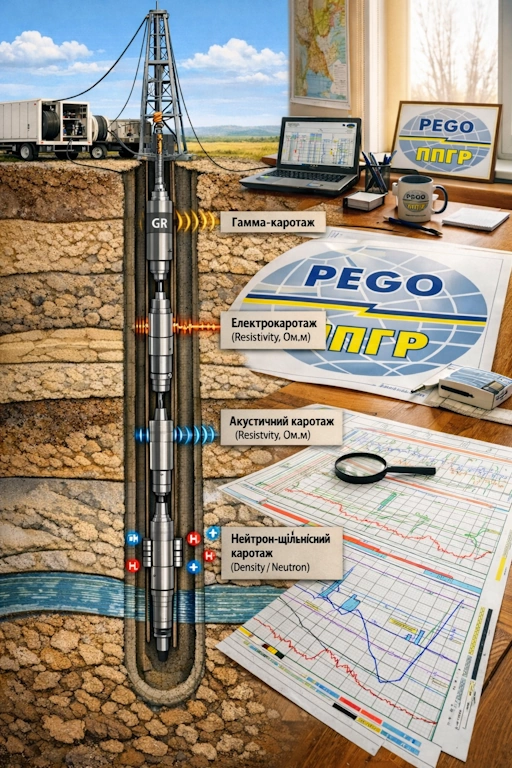
After reaching the target depth, well log interpretation becomes the foundation for reserve estimation and the selection of testing targets. The company’s specialists utilize a suite of methods (electrical, radioactive, and acoustic logging) to address key issues:
- Determination of fluid saturation: Distinguishing oil- and gas-bearing formations from water-bearing ones.
- Calculation of Coefficients: Porosity, shale content (v-shale), and oil/gas saturation.
- Geomechanical Modeling: Analyzing wellbore stability and selecting optimal perforation intervals.
3. Geophysical Support During Production
Once the well is in operation, the role of interpretation remains vital. Reservoir management requires constant monitoring:
- Well integrity assessment: Identifying casing defects and behind-casing cross-flows (cement bond logging/CBL).
- Inflow and Injection Profiles: Determining which formations are productive and which require stimulation.
- GOC/OWC Monitoring: Tracking the movement of gas-oil and oil-water contacts to prevent premature water breakthrough.
High-quality interpretation of geophysical data is a tool for minimizing capital expenditures (CAPEX). Through professional analysis provided by “Poltava Enterprise of Geophysical Operations” (PE “PEGO”), the client receives more than just a set of logs—they get a clear roadmap for efficient subsurface development.
Our Technologies and Data Interpretation
The success of every project at “Poltava Enterprise of Geophysical Operations” (PE “PEGO”) is built on a combination of our specialists’ long-term experience and the use of world-leading software.
Professional Data Interpretation
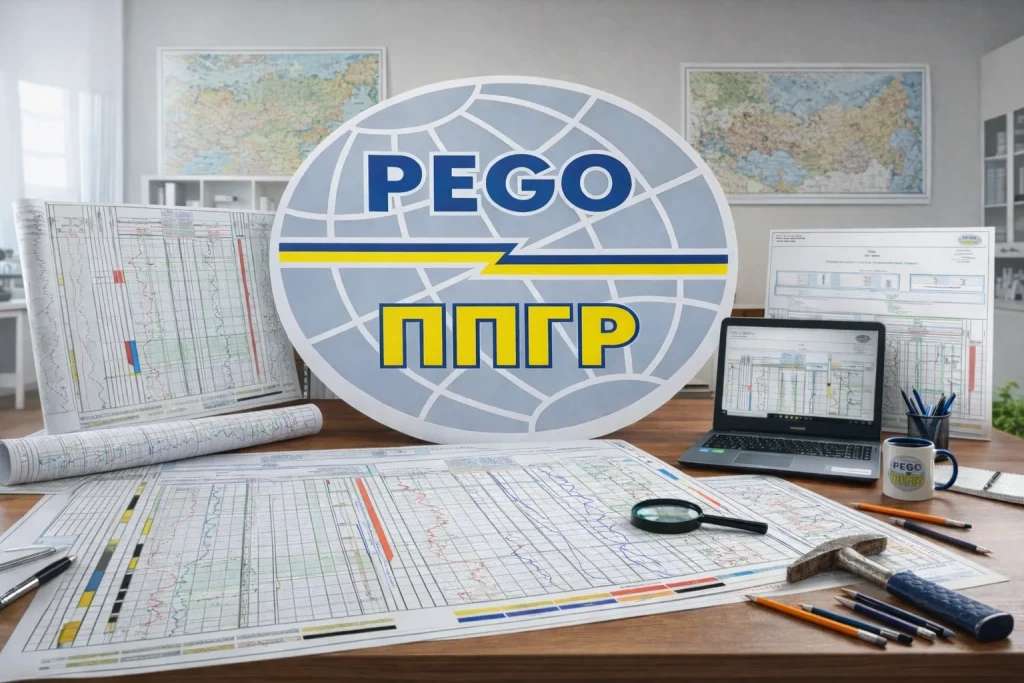
The quality of geological reports and the accuracy of recommendations provided by PE “PPGR” are based on the use of modern licensed software. Our geological department specialists perform advanced digital data processing, enabling clients to minimize risks and optimize production.
- Scarlet Production Logging — specialized analysis of operating well performance and fluid inflow composition.
- GeoBase — efficient database management and systematization of geological and geophysical information.
- Opium — a powerful tool for rapid processing and high-quality interpretation of well logging data.
- CardLine — creation of high-precision well logs (plots) and detailed 3D visualization of survey results.
Data Compatibility and Transfer Standards
We value our clients’ time, which is why we provide interpretation results in any convenient digital format compatible with international standards (e.g., LAS, PDF, ASCII, LIS). This allows for the instantaneous import of our data into your internal reservoir modeling systems.
The use of licensed software guarantees our partners the legal integrity of all reporting and the highest reliability of the obtained results.
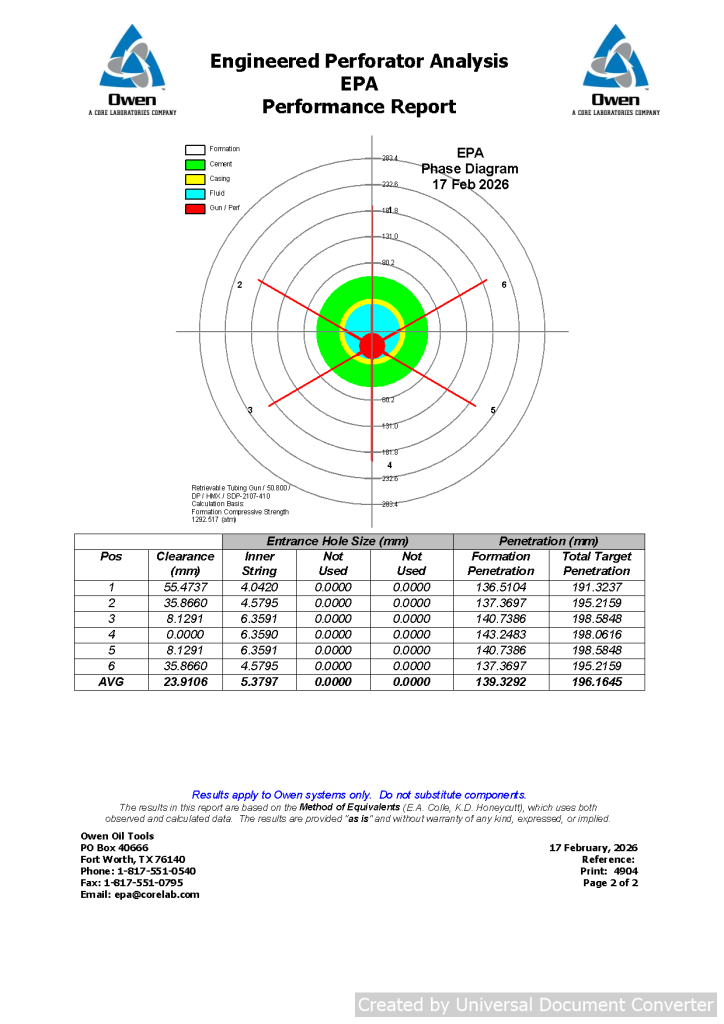
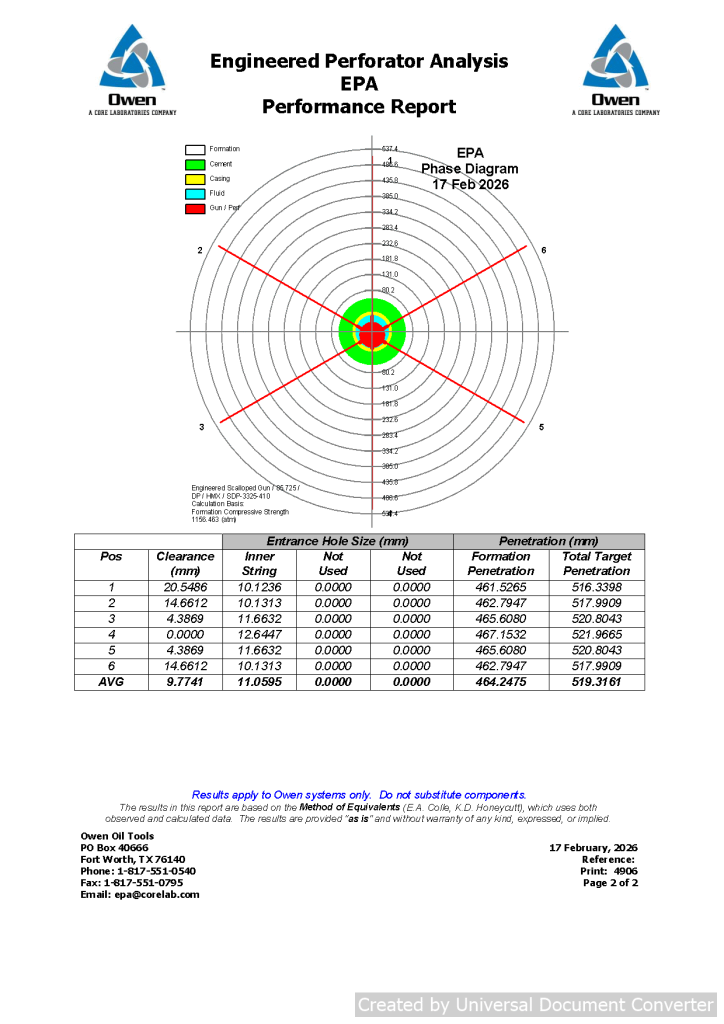
High-Precision Perforation Modeling
To ensure maximum fluid inflow and optimize formation exposure, we utilize specialized EPA (Explosive Performance Analysis) software. This allows us to perform mathematical modeling of perforation processes, predict their effectiveness, and minimize risks to casing integrity. This enables us to:
- Calculate optimal parameters for perforation and blasting operations.
- Predict penetration depth and filtration area.
- Select perforation systems customized to the specific geological and technical conditions of the well.
With our powerful software suite, we guarantee our clients high forecast accuracy and well-founded management decisions in reservoir development.